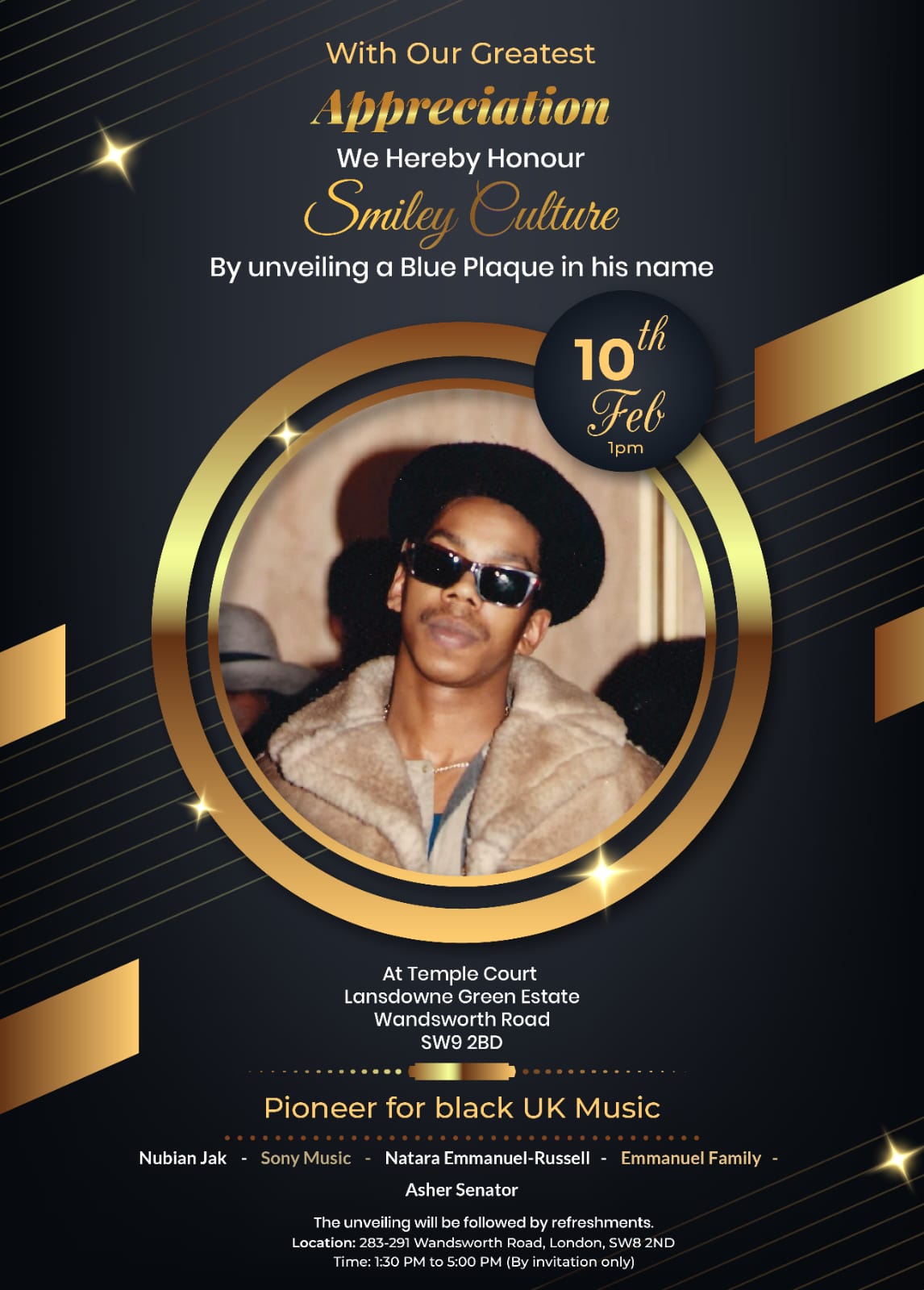
I want to reflect on the recent unveiling of a Blue Plaque in honour of the British rapper, Smiley Culture. The event was jointly supported by The Nubian Jak Community Trust, Sony Music UK, and the Emmanuel family. The “event mark[ed] an incredible milestone in recognising Smiley Culture’s impact as a cultural bridge, musical trailblazer, and voice of the people [and] … celebrate[ed] his enduring legacy and contributions to Black British heritage. We were joined by JP Ennis, the Mayor of Lambeth, Charlotte Edgeworth from the Sony Music Justice Fund, musical collaborators Asher Senator and John Dub Vendor, as well as Smiley Cultures family. It was an honour to meet Smiley Culture’s family who had been generous enough to invite me to participate alongside his grandson Zaire’s incredibly moving and impressive performance of Smiley Culture’s single Cockney Translation
Personal thoughts (scroll to the good bit if it makes you feel icky)
Lockdown is hard. Shielding is hard, and if I didn’t have such an amazing community of support around me, it would be so much harder. And I am shielding in the most privileged of circumstances. It is safe where I am. As many others have noted, the medical conditions that put me in the ‘extremely vulnerable’ camp, have also given me a load of tools, and lowered expectations, to get through the day. One of the things that has really got to me, however, is not something that I saw coming. Feeling vulnerable rather than valuable, and reliant rather than productive has shone a light on my value structure; for good and for ill. We know that the productivity drive in lockdown is unhealthy, but when a team of people that I have always enjoyed working with got in touch and floated an idea I was grateful, and excited.
Intellectuals Unite
I am excited to announce that from Monday 11th May 2020 I will be curating Vivienne Westwood’s Intellectuals Unite book club online on my Instagram @ProfLRobinson
I started meeting, talking and thinking with Vivienne and her IOU: Intellectuals Unite in 2016. What struck me straight away was that this is not some retro punk celebration, especially at the time of the 40th anniversary of punk celebrations. Intellectuals Unite and Climate Revolution are not a nostalgic rerun of the prank anarchism of 1977. They are a group of people, who have conversations that were very much rooted in the now and focused on the future. Although much of my work has focused on subcultures, sex, drugs and rock n roll, my involvement with Intellectuals Unite was based on my background as an activist and my historical research on structures of protest and political organisation.
The group, who meet, share tactics, and discussions across local and national issues was inspired by a variety of moments, by new community models, the legacies of the 2011 urban protest, the junior doctors strike, student campaigns for greener economically and environmentally sustainable campuses, for example. One of the practical strands has been Vivienne’s support of alternative electricity and utility providers as a way to undermine the power of the fossil fuel’s political lobby.
The politics of Vivienne’s vision however extends beyond the academy. Her starting point is that we are all intellectuals. If you think about the world; if you participate in it critically and culturally – then you are an intellectual too. The context in which we find ourselves forces us to do just that. The circuits of exchange between resistance or protest and intellectual analysis is often only imagined in one direction, where the work of great thinkers influences the public, or perhaps more commonly, intellectuals pick up on the concerns and approaches of the public, and then frame them as their own intellectual interventions.
“Any kid off the street who wants to go on a demonstration to find out what’s happening – come and join us, you are an intellectual. We have to unite. It’s the only thing that can really challenge the government’s lies.”
“The literary ethos of the 19th Century sometime after the reign of Napoleon around 1830 up to WW1. Going back, the evolution of the novel began before printing at a time when Kings and Queens and rich people lived in castles and palaces, and books were expensive. What started as ‘[h]eroic stories of romance and chivalry’, became the literary form where every strata of society could find themselves represented – if not necessarily in terms that they would choose.”
As someone who misses her Grandchildren so much that it hurts and has been trying to maintain a connection with them by sharing books with them online, this totally struck a chord.
But more than that. This is the literature that I grew up loving, grew in confidence studying, and, I hope, could help us to feel connected to both each other and to the past, in these extraordinary times. The 19th century novel demands that we find ourselves in the bigger picture. The expansiveness of the novel’s totality takes us outside of our own carefully measured safe distances from each other.
Books’ characters are our comrades.
In Vivienne’s Manifesto Get a Life, Alice and Pinocchio are fellow travelers who accompany us in Active Resistance.
My hopes are that by sharing these books, we can join collectively with these fellow travelers. Reading (in all its forms) as a pastime might help us in this time. Reading as a process might connect us through a shared experience, and reading as an analysis might help us think about what lessons for today we learn from the literature of the past.
How will it work?
Vivienne will share her book recommendation every two weeks. We will share an introduction to the book, thinking about things to look for, contextual background and ideas to think about. We will hold a virtual book club, with questions and discussions. I’m going to rope in colleagues and friends that I miss talking to as well. Pam Thurschwell has agreed to come and hang out with us.
She shared her thoughts with me about the power of the novel in the current moment:
“Novels matter in the time of coronavirus because art makes connections between people, even in the absence of hugs and handshakes; novels help build our shared understandings of our worlds. The 19th century European novel was centrally focused on what binds us together into that thing that Margaret Thatcher insisted did not exist, ‘society’. But novels have also always charted what breaks us apart, the sense of ourselves as isolated individuals. George Eliot describes the ties that connect her many characters to each other and to the provincial town of Middlemarch as a “web”; this image of intricate spidery connectedness might seem both comforting and entrapping. We need our webs and we fight against them. By contrast one of the works we like to call the first novel in English was Daniel Defoe’s Robinson Crusoe from 1719, the story of the hardy shipwrecked colonialist Crusoe, building his domain with a single subject, the black slave Friday. The realist novel gives us stories of love death, and domination, sex, work, scandal and money (always money), but also tells us how we fit into the webs that surround us.”
We want to want to find a space to think about virtual and literary communities. Can Instagram be this moment’s literary salon? Vivienne is always clear how much she values the book as a physical object and like a lot of academics, my bookcases are a form of autobiography (another privilege). But reading comes in many forms. This might be audiobooks, or a screen reader, eBooks, or a variety of different adaptions available form BBC sounds or iPlayer for example.
We want to find as many ways to get people involved and providing content as possible.
Send videos of your reactions to the books to be collated for the live event. Email me your thoughts and reviews, as text or as videos. Particularly if you have thoughts about how reading as a past-time, process, or analysis is helping you to make sense of a society in lockdown.
Our first Book Club will be Monday 25th May, time tbc
This post was originally commissioned by the CIRCY blog. Many thanks to Janet Boddy for all her support. I’m working to develop this into a broader project so thought I’d revisit it for a bit.
The Indie Rock-a Nore Festival was held on 21st October 2017 at the Hastings and St Leonards Angling Association. It was “[a] one-day indie-pop festival (midday to midnight), bringing together current indie bands and those of yesteryear. Raising money for Brighton based suicide prevention charity, GrassRoots, who provide support across East Sussex (Charity Number: 1149873)”. Alongside the bands there was a raffle, a pool tournament and a buffet. CIRCY made a small contribution to hosting costs, ensuring that all money taken on the door could go straight to the charity. Over £2500 was raised on the day.
The history of queer representation in film is sometimes the history of not being easily seen. It can be the history of having to work really hard to find yourself represented. It can be the history of having to work really hard with what you are given, when you are represented as the freak, the pervert, the duplicitous spy, the blackmailer.
Queerama for me, was the story of how people have negotiated the identities that have been imposed on them. As a history Queerama shows us a series of outside definitions of queer identities that have had to be negotiated; homosexuality, for example, has been seen as a sin, an illness, to an act of dissidence. Sexualities and their identities have been legislated and defined from above, diagnosed by sexologists, feared for contagion, dissected like a guinea pig, but they have also been squeezed through the cracks.
These are the words I gave at last night’s amazing, angry, joyful, loving, demo against Trump and his muslim ban. I know most of the thousands of people couldn’t hear what the speakers were saying. Because there were just so many of you there. Your bodies filled the space, soaked up the sound and responded with chants, shouts and woops. (Note, just because you might think you’ve got the biggest megaphone, doesn’t mean you have. Believe me I know, I’ve tried them all)
Over the last few months a new feminist project has been occupying a small group of feminist historians at the University of Sussex. #MorethanAssistants is inspired by the history of feminist interventions in Historical practice.
We are concerned with
The burden of responsibility on those few female figures who manage to earn a space in the public realm.
The disproportionate shaming of young women for unruly behaviour.
The power of playful, messy, feminism.
The importance of carrying our sisterhood with us, whether physically, virtually or emotionally
An assault on an all female band by a member of security staff at this weekend’s Undercover punk festival in Brighton has brought the online mansplainers and slut shamers out of the woodwork. It also raised some issues that need to be resolved, some feel new, some are as old as punk itself. Can women make a new space in a scene and politicize it from within ? Is there ever a way to reconcile the punk politics of the past, and the intersectional politics of the present? Can we actively build a politics where race, gender, age and subcultural identity intersect ?– the answer, it seems to me, to all of these questions is the same; not really, no. Continue reading Your punk politics will be privileged, or it will be bullshit→
I’ve been out of the country for a week at a great workshop in Berlin “How to Write and Conceptualize the History of Youth Cultures” organised by Felix Fuhg, Doctoral Student, with the Centre for Metropolitan studies. I was travelling with the histrrry girls and The Subcultures Network, so there were Harringtons. There are always Harringtons. We spent one day working and talking in the Archiv der Jugendkulturen. Its an incredible community archive and library that has brought together all the different traces of resistance in youth culture and subcultures. From magazines made by school pupils to the Love Parades’ backdrops and giant cut outs of Nena – the transational and hyper local are boxed up together and are being carefully catalogued by local participant experts in each scene.
So in keeping with the more recent tone of NTWICH I’m going to start this post with a confession. I avoided seeing the film Pride for nearly 16 months and only eventually watched it because I had to.
In the end I watched it because Catherine Grant very kindly invited me to speak at an event that she organised with Diarmaid Kelliher, on Pride and its Precursors and I was too honoured, and too embarrassed, to say no. When the film first came out I ducked and dived out of numerous press requests to comment on it. I had toyed with the idea of presenting at the symposium without actually having watched the film, maybe as a sort of thought experiment. I’d floated the idea over drinks with the talented historian Ben Jones from UEA but lost my confidence after he described some of the scenes I might have missed out on (the alien invasion and massive shoot out at the end).
Over the past few weeks Class War and LSE’s Lisa Mckenzie in particular have been taking a lot of stick for their choice of target and tactics. For months Class War and the Women’s Death Brigade have been standing up against the relocation of young teenage mothers by supporting E15 Mums’ campaign, opposing Poor Doors, challenging Gay Pride’s for profit associations with big business and international banking, and exposing the dodgy deals and marketing of working class women’s bodies for profit at the Jack the Ripper Museum in Cable St. All pretty straight forward. Not everyone likes the shouty, irreverent style of the brigade, but its pretty hard to defend kicking out teenage mums, humiliating social housing tenants, censoring gay activists in the name of Pride, or possible shonky negotiations for planning permission. But then Class War went too far. They went for the hipster – and the infamous Cereal Killer Café. Jokes were made on Radio 4 quizzes. Newspapers dug around in activist’s private lives and recreational choices for a few exposes. Friends of mine argued that these were the wrong targets and the wrong tactics. I’m not going to get into analysis of cultural capital and bearded entitlement (but honestly doesn’t your face take up enough space already?). But I found it difficult to see the cereal café as the biggest victim in the struggle around austerity.
Fair enough, the other side of that coin is that the bearded cereal sellers might not be your biggest problem either. In fact you might not have heard about all the grassroots activism that Class War and the Fuck Parade had been doing if they hadn’t annoyed Shoreditch. [disclaimer – I am gluten and lactose free so cereal prices are never going to be my biggest issue] But the issue of personal taste, and personal tactics really isn’t the problem anymore. The truth is, it doesn’t matter what your personal political style is. It doesn’t matter how your particular political form and content sit together. Because whether you like it or not, whether we like each other’s style or not, we really are all in it together. If we didn’t know that already, the CPS have just made it very clear.