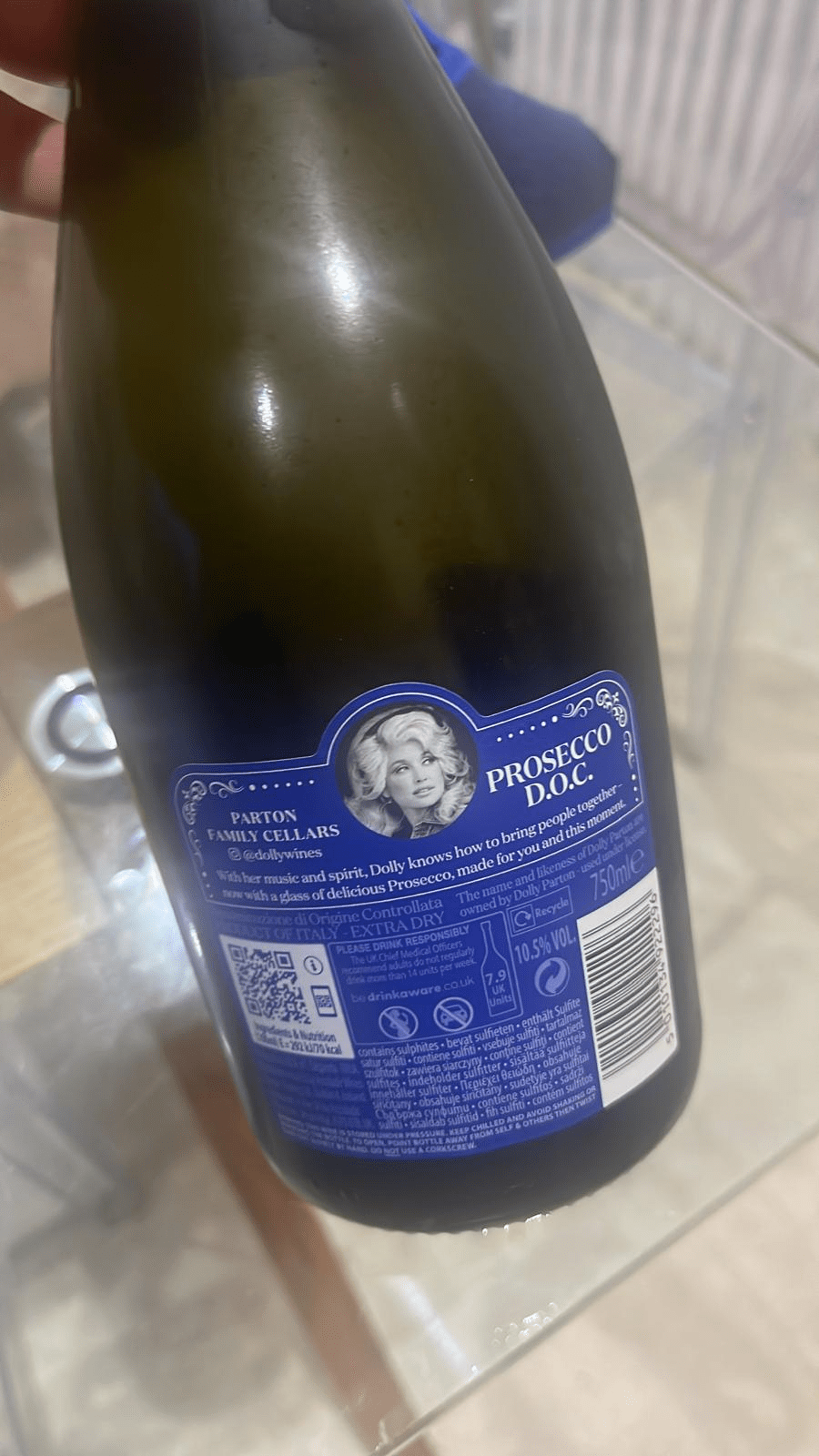
Along with pretty much everyone else, I’ve had my head and heart full of Dolly. She means a lot to me and my family. I have a large back tattoo of ‘islands in the stream’ in which each island represents a close family member. At our wedding reception at the local pub people were awarded a badge with either Dolly or Kenny’s face on it, dictating which part they would sing at the karaoke mass sing along. When my mum died, my oldest grrrl toasted her life with the last bottle of Dolly’s prosecco.
On numerous difficult health days my mantra has long been ‘better get to livin’.
For a number of years I submitted a request for Dolly to be nominated for an honourary degree from the University of Sussex. It never happened. But in recognition of of how fucking cool it could have been, here is the form I submitted (Note this is pre-pandemic)
CONFIDENTIALUNIVERSITYOF SUSSEX
HONORARY AWARD NOMINATION FORM
Name of individual being proposed for an Honorary Award:Dolly Parton
Alumnus/a of the University? /NO
Please set out why you think the University should honour this individual by completing Box 1, Box 2 (optional) and either or both of boxes 3 and 4:
Box 1
Set out in this box the achievements of the individual in respect of what has made them distinctive having achieved excellence in their field.
Dolly Parton has played an important public role contributing to the development, progress and change in society. Her work, crossing philanthropy, education, popular culture and maintaining a public awareness of the history of folk narratives is an excellent match for the interdisciplinary, public facing, and bottom up approaches that Sussex has been founded on. She is the world’s most recognisable female country singer, an advocate for children’s literacy and spokeswoman for equality for women. Her work takes the heritage and history of marginalised people and turns them into something to be publically explored and enjoyed. Dollywood for example, combines the history of her own career with the preservation of local skills such as, glassworking, grist milling, and foundry work. She has foregrounded the role of musical education as an important element of community heritage. Her songwriting, is as important as her own performance.
As a musician, song-writer, television performer, writer and actress, stories, and storytelling are at the heart of her musical and heritage work. The ethos of the Dollywood Resort, is based on ‘the rich traditions of storytelling, family and togetherness’
Beyond her worldwide reputation as a performer and her work maintaining the importance of everyday heritage, she is a significant philanthropist in areas of direct connection with Sussex. Her Dollywood Foundation has been raising funds through concerts since the 1990s.
Her ‘Imagination Library’ was established in 1995 and send one book per month to children from birth to school. This has made an important contribution to awareness of childhood literacy rates and has directly impacted thousands of children’s future engagement with education. Children in the USA, UK, Canada and Australia have directly benefitted from this programme. Over 750,000 children in 1600 different communities receive these books. Research has already found significant improvement in early childhood literacy for children enrolled in the program. Further studies have shown improved scores during early literacy testing. Like Dolly’s stories in song, this work is based on the transformative potential that education has for social mobility.
She is a key spokesperson for the Save the Music Foundation which is dedicated to re-introducing music education, and the importance of music as a form of community participation.
Her importance as a philanthropist has been recognised by the Association of American Publishers, GoodHouskeeping, American Association of School Administrators, National State Teachers of the Year and Parents as Teachers National Center.
Box 2 (NB completion of this box is optional)
Set out in this box how the award to the individual might reinforce the University’s key strategic objectives or increase the profile of a particular area of the University.
Dolly Parton embodies the key areas that Sussex has an international reputation; in community and folkloric heritage, literacy and public engagement, and as an advocate for young women and the LGBTQ community.
Our world leading American Studies dept. engages with histories of class, popular culture and politics. Our Centre for Innovation in the Study of Youth and Childhood brings together outward engagement with young people, and research on the significance of early and positive experiences of music and literacy education. She has been a long standing ally of the LGBTQ community, particularly working hard to raise issues of equality to rural and Christian communities who are so often ignored in discussions around equality and sexuality. She has publically advocated gay marriage and transrights.
Finally, her work establishing and maintaining a history of country, and folk music is very much in line with Sussex’s roots in folkloric and people’s history through popular culture. These can be traced back to Sussex’s role in the History Workshop and to our unique archival holdings on the Copper Family, for example.
Her Dollywood Foundation collects, curates and values the role of story telling as a shared heritage, something that fits exactly with Sussex’s reputation as a world leader in oral and life history methods.
Box 3
Set out in this box the individual’s previous contribution to, or relationship with, the University.
Her work has influenced and inspired many of us, particular in recent discussions around gender, and popular cultural history.
Box 4
Set out in this box the individual’s potential future advocacy or support for the University.
Dolly Parton’s worldwide reputation would help raise Sussex’s profile as a university that takes popular culture and its educational role seriously. She has a particularly inspiring impact on young women and the LGBT community. We are a university that have invested in the transformative possibilities of education, of the importance of taking people’s own histories seriously. From her impoverished background she has used the culture and heritage around her to build a global career, nominated for an Emmy, Grammy, Oscar and Tony. Inducted in the Country Music Hall of Fame and the National Academy of Ppoular Music, Dolly Parton was recognised as an official ‘Living Legend’ by the US Library of Congress in 2004. As a role model for women, she is second to none. In the current context of ‘lad culture’, and pornification of young women, Sussex would do well to have an older woman who can critique and analyse gender from within as a celebrated role model. She is a woman who connects with millions of women across generations, as the mass appeal of the film 9 to 5, andher appearance at Glastonbury festival showed. They connect with her for a reason. She brings a rich heritage of folk practices and experiences of social mobility and applies them practically in today’s society.
Dolly Parton would be an excellent honorary member of CIRCY, for example. Over the last year there has been a considerable growth in ‘Girls Studies’ in the UK. CIRCY and the Centre for Sexual Dissidence are well positioned to organise a major international conference in this area. Dolly Parton would be the ultimate keynote at such an event.
It feels like a long time ago since three UCU members witnessed the treatment of young people on a demonstration for the right to access education. We wrote a report on what we had seen, collectively and with urgency. It has definitely informed a lot of my work and thinking since. In particular it inspired my involvement with the Subcultures Network which aimed to uphold some of the agency afforded to young people in the earlier models of subcultural resistance, but with a more nuanced twist. The experience of witnessing the protest and writing the report also greatly informed my thinking about publics and the crowd that went into my 80s book, most notably work by John Drury.
When it was published the police were very disappointed in us –
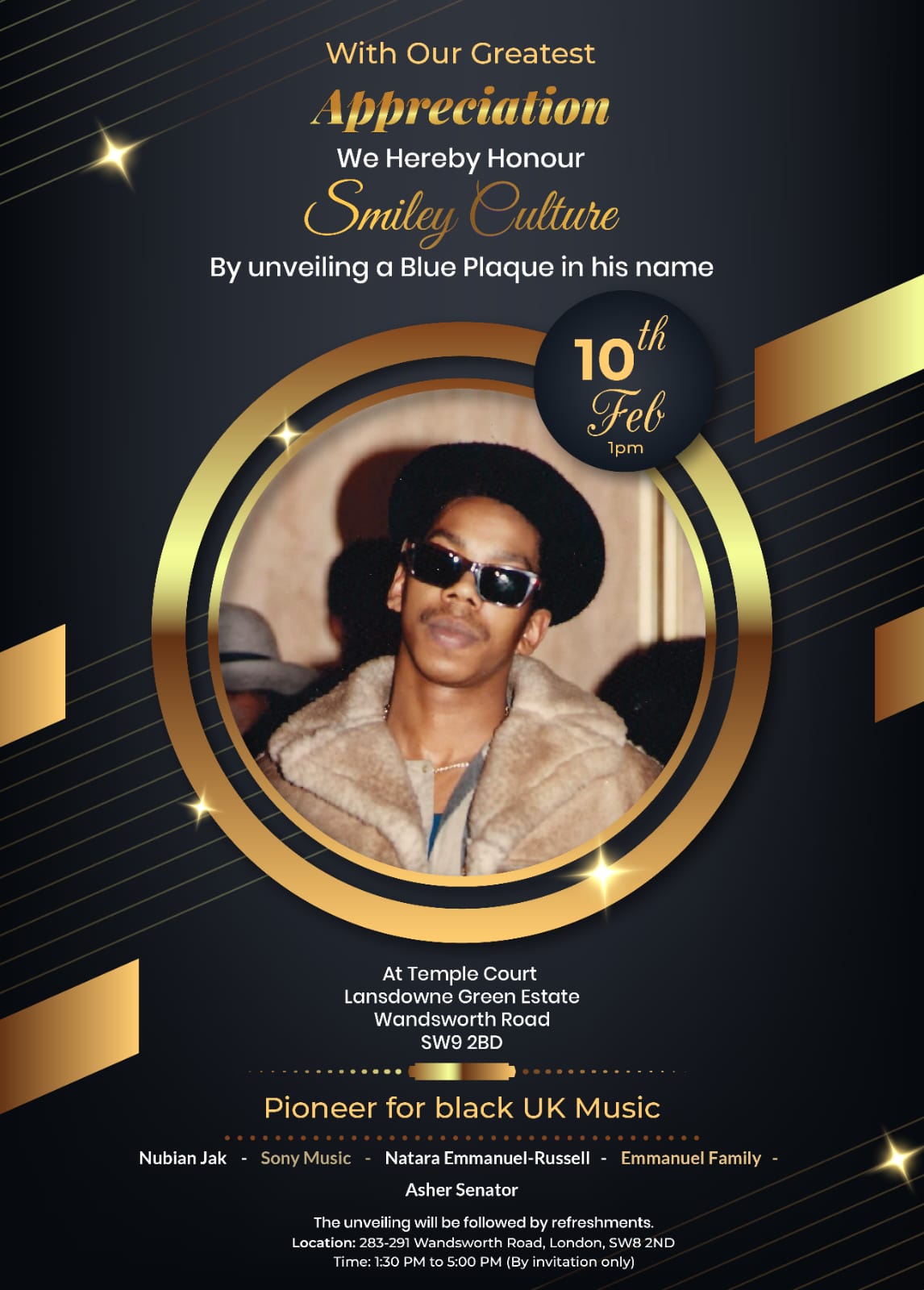
I want to reflect on the recent unveiling of a Blue Plaque in honour of the British rapper, Smiley Culture. The event was jointly supported by The Nubian Jak Community Trust, Sony Music UK, and the Emmanuel family. The “event mark[ed] an incredible milestone in recognising Smiley Culture’s impact as a cultural bridge, musical trailblazer, and voice of the people [and] … celebrate[ed] his enduring legacy and contributions to Black British heritage. We were joined by JP Ennis, the Mayor of Lambeth, Charlotte Edgeworth from the Sony Music Justice Fund, musical collaborators Asher Senator and John Dub Vendor, as well as Smiley Cultures family. It was an honour to meet Smiley Culture’s family who had been generous enough to invite me to participate alongside his grandson Zaire’s incredibly moving and impressive performance of Smiley Culture’s single Cockney Translation
Get involved with our Born Digital DejaLockdown Zine.
Listen to our masterclasses, explore online archives and contribute to a zine built by us together.
Join in our collaboration between Post-Rave Britain, The Subcultures Network, and Intellectuals Unite Bookclub
The last official lockdown encouraged us to come together and find ways to build a sense of community, fill our time and make sense of the perpetually unprecedented. Whilst some of us have been shielding throughout for most of us returning to lockdown mark II is daunting, frustrating…. (fill in your own emotional responses here……)
We will have exciting announcements about the book club’s return soon but alongside that we wanted to get something new going too.
In the precedented world this would be the point in term when myself and Chris Warne would be gathering old magazines, ordering glue sticks and Tippex to run our (fan)zine making workshop with our third year Special Subject students on ‘Post-Rave Britain’.
Personal thoughts (scroll to the good bit if it makes you feel icky)
Lockdown is hard. Shielding is hard, and if I didn’t have such an amazing community of support around me, it would be so much harder. And I am shielding in the most privileged of circumstances. It is safe where I am. As many others have noted, the medical conditions that put me in the ‘extremely vulnerable’ camp, have also given me a load of tools, and lowered expectations, to get through the day. One of the things that has really got to me, however, is not something that I saw coming. Feeling vulnerable rather than valuable, and reliant rather than productive has shone a light on my value structure; for good and for ill. We know that the productivity drive in lockdown is unhealthy, but when a team of people that I have always enjoyed working with got in touch and floated an idea I was grateful, and excited.
Intellectuals Unite
I am excited to announce that from Monday 11th May 2020 I will be curating Vivienne Westwood’s Intellectuals Unite book club online on my Instagram @ProfLRobinson
I started meeting, talking and thinking with Vivienne and her IOU: Intellectuals Unite in 2016. What struck me straight away was that this is not some retro punk celebration, especially at the time of the 40th anniversary of punk celebrations. Intellectuals Unite and Climate Revolution are not a nostalgic rerun of the prank anarchism of 1977. They are a group of people, who have conversations that were very much rooted in the now and focused on the future. Although much of my work has focused on subcultures, sex, drugs and rock n roll, my involvement with Intellectuals Unite was based on my background as an activist and my historical research on structures of protest and political organisation.
The group, who meet, share tactics, and discussions across local and national issues was inspired by a variety of moments, by new community models, the legacies of the 2011 urban protest, the junior doctors strike, student campaigns for greener economically and environmentally sustainable campuses, for example. One of the practical strands has been Vivienne’s support of alternative electricity and utility providers as a way to undermine the power of the fossil fuel’s political lobby.
The politics of Vivienne’s vision however extends beyond the academy. Her starting point is that we are all intellectuals. If you think about the world; if you participate in it critically and culturally – then you are an intellectual too. The context in which we find ourselves forces us to do just that. The circuits of exchange between resistance or protest and intellectual analysis is often only imagined in one direction, where the work of great thinkers influences the public, or perhaps more commonly, intellectuals pick up on the concerns and approaches of the public, and then frame them as their own intellectual interventions.
“Any kid off the street who wants to go on a demonstration to find out what’s happening – come and join us, you are an intellectual. We have to unite. It’s the only thing that can really challenge the government’s lies.”
“The literary ethos of the 19th Century sometime after the reign of Napoleon around 1830 up to WW1. Going back, the evolution of the novel began before printing at a time when Kings and Queens and rich people lived in castles and palaces, and books were expensive. What started as ‘[h]eroic stories of romance and chivalry’, became the literary form where every strata of society could find themselves represented – if not necessarily in terms that they would choose.”
As someone who misses her Grandchildren so much that it hurts and has been trying to maintain a connection with them by sharing books with them online, this totally struck a chord.
But more than that. This is the literature that I grew up loving, grew in confidence studying, and, I hope, could help us to feel connected to both each other and to the past, in these extraordinary times. The 19th century novel demands that we find ourselves in the bigger picture. The expansiveness of the novel’s totality takes us outside of our own carefully measured safe distances from each other.
Books’ characters are our comrades.
In Vivienne’s Manifesto Get a Life, Alice and Pinocchio are fellow travelers who accompany us in Active Resistance.
My hopes are that by sharing these books, we can join collectively with these fellow travelers. Reading (in all its forms) as a pastime might help us in this time. Reading as a process might connect us through a shared experience, and reading as an analysis might help us think about what lessons for today we learn from the literature of the past.
How will it work?
Vivienne will share her book recommendation every two weeks. We will share an introduction to the book, thinking about things to look for, contextual background and ideas to think about. We will hold a virtual book club, with questions and discussions. I’m going to rope in colleagues and friends that I miss talking to as well. Pam Thurschwell has agreed to come and hang out with us.
She shared her thoughts with me about the power of the novel in the current moment:
“Novels matter in the time of coronavirus because art makes connections between people, even in the absence of hugs and handshakes; novels help build our shared understandings of our worlds. The 19th century European novel was centrally focused on what binds us together into that thing that Margaret Thatcher insisted did not exist, ‘society’. But novels have also always charted what breaks us apart, the sense of ourselves as isolated individuals. George Eliot describes the ties that connect her many characters to each other and to the provincial town of Middlemarch as a “web”; this image of intricate spidery connectedness might seem both comforting and entrapping. We need our webs and we fight against them. By contrast one of the works we like to call the first novel in English was Daniel Defoe’s Robinson Crusoe from 1719, the story of the hardy shipwrecked colonialist Crusoe, building his domain with a single subject, the black slave Friday. The realist novel gives us stories of love death, and domination, sex, work, scandal and money (always money), but also tells us how we fit into the webs that surround us.”
We want to want to find a space to think about virtual and literary communities. Can Instagram be this moment’s literary salon? Vivienne is always clear how much she values the book as a physical object and like a lot of academics, my bookcases are a form of autobiography (another privilege). But reading comes in many forms. This might be audiobooks, or a screen reader, eBooks, or a variety of different adaptions available form BBC sounds or iPlayer for example.
We want to find as many ways to get people involved and providing content as possible.
Send videos of your reactions to the books to be collated for the live event. Email me your thoughts and reviews, as text or as videos. Particularly if you have thoughts about how reading as a past-time, process, or analysis is helping you to make sense of a society in lockdown.
Our first Book Club will be Monday 25th May, time tbc
Last week I had the honour of acting as discussant at a panel on Modern Britain On Drugs at this year’s MBS conference at Birmingham University. (It was a really great conference, but more on that another time.)
Peder Clark, London School of Hygiene and Tropical Medicine: ‘“Do You Love What You Feel?”: Ecstasy, Rave, and Ways of Knowing, 1988-1995’.
Ben Mechen, Royal Holloway ‘Rubber Gloves and Liquid Gold: Poppers and the Policing of London’s Queer Nightlife’.
Yewande Okuleye, University of Leicester ‘You Call It Marijuana and I Call It “The Herb”: Cannabis as a Boundary Object’.
I just gave an inaugeral. The most terrifying and life affirming thing I’ve ever done at work. It was a room full of amazing people – I was blessed to have four generations of my family there and loved the opportunity to make my 89 year old mum and my 7 year old grandson all swear in unison.
There’s a recording coming at some point, but there are some things that I really want to share, in a written form, for those who might not be interested in the main body of the talk itself, but might be facing similar questions in their negotiation with the academic structures around us.
How the fuck are we going to get through this shitstorm, intact, together, and without throwing each other under the bus? Who has got our back? and what can we learn from those who have negotiated the faultlines of the shitstorm before us?
I want to think about the possibility of working, together, kindly with respect. When your own institution lists ‘kindness’ as one of its key strategies there are interesting possibilities in the feelings at work, at work.
We will seek to be known as a ‘kind’ institution. We will care for each other and for the world around us, in responsible and sustainable ways. We will value collegiality and mutual support across all of our actions and activities. Sussex2020 Strategic Framework
So this blog is a way to explore how to protect the parts of ourselves that we give away when our personal is political. As Sara Ahmed says ‘to live a feminist life is to be a feminist at work’. But that means my institution gets a whole load of stuff out of me that was never in my job description. It means that when I’m evaluated, fedback upon, quantified, its not just my outputs, but my whole personal and political self that’s being measured. Furthermore, feminism is a beautiful, stretchy, broad old chorus, and its never simple when ‘being a feminist at work’ is by necessity informed by your own personal as political.
The UCU strike for USS has been a roller coaster and I don’t really know what it means yet, being a historian and all. But the strike over pensions and the marketization of universities has changed how I understand our structures and possibilities and how I feel about work, and how I feel about feeling things about work. (But I will leave the truly brilliant Claire Langhamer to take that one on) Its also changed the way academics in different institutions relate to each other, and filled our lives with Twitter.
I’ve never had an overly easy relationship with Universities, or really with education, but over the last few weeks I’ve never felt so completely at home in academia, or wanted to leave academia so much.
Yesterday we finished the first day of a 14 day action, a financial sacrifice that will be compounded by a 20% pay cut for action short of a strike. This kept me up at night.
I’ve said it before, and I’m sure I’ll say it again – “Other people’s tactics are not the problem’. So why then was it the support for the strike, rather than any opposition that kept me up at night?
I really don’t want to sound ungrateful, and I do not take student support for strike action for granted. So why do I find it so uncomfortable when students demonstrate their support for me through their individual consumer rights? Why doesn’t their consumer pressure for compensation for hours lost in the current strike in defence of our pensions make me feel defended?