Category Archives: The Eighties

‘Political protest and the police: young people in Brighton’ by Tom Akehurst, Louise Purbrick and Lucy Robinson (2011)

It feels like a long time ago since three UCU members witnessed the treatment of young people on a demonstration for the right to access education. We wrote a report on what we had seen, collectively and with urgency. It has definitely informed a lot of my work and thinking since. In particular it inspired my involvement with the Subcultures Network which aimed to uphold some of the agency afforded to young people in the earlier models of subcultural resistance, but with a more nuanced twist. The experience of witnessing the protest and writing the report also greatly informed my thinking about publics and the crowd that went into my 80s book, most notably work by John Drury.

When it was published the police were very disappointed in us –

“We have serious reservations about the methodology and academic rigour, given its quick publication and the researchers’ reluctance to engage with a key party to the events.”

“We take very seriously our legal and moral duties to carefully balance people’s right to peacefully protest with our duty to protect the public. We are extremely disappointed that the same balance has not been applied to the undertaking of this research.

Which we felt was slightly unfair as there was a mirror project working on police experiences elsewhere in Brighton and the ethics advice had been to separate this from the experiences of young people.  My own university made a statement distancing themselves from the content of my research  – which is nice because I’m not sure they are usually that aware of what I do. Young people were condemned in the local newspaper and by the bloggers who post on local paper’s website: they were trouble-seeking truants, looters, criminals, too stupid for university, and “feral”, the adjective of choice for children who do not, for a host of reasons, conform. Which all seemed to me to rather prove our point.

As our times have moved on, on the protests of 2010 and 2011 have been superseded by other moments of unrest not least #BLM, and the Report has now become officially historical. It is an example of how historians at the time were working out to apply the historians’ craft to new social media forms, in this case Twitter and Youtube, and what ethical approaches we should be led by. We use the Report as evidence in our first year History module The History of Now in which students collectively write the history of the 21st century through three intertwined layers of the history of the discipline, the documenting of events, and their own lives.

Because the Report is quite long if you wanted to use it for teaching I recommend choosing one of the following for source analysis.

  • ‘Introduction’ (pp. 5-13)
  • ‘Hove Town Hall’  (pp. 58-62)
  • One other event of your choice – you might choose a location that you recognise for example
  • ‘Kettling’ (pp. 73-75)

Alongside the following historical work:

Eric Hobsbawm & Tristram Hunt, The Observer (London), 16/1/2011, A conversation about Marx, student riots, the new Left, and the Miliband brothers

Smith, Evan. “Once as history, twice as farce? The spectre of the summer of ‘81 in discourses on the August 2011 riots.” Reading the Riot Act. Routledge, 2018. 36-55.

Hancox, Dan, Why our ideas about protest and mob psychology are dangerously wrong, The Guardian, 23/10/2024

CAPPE originally hosted the report but the link is no longer available. But luckily enough we have the Wayback Machine
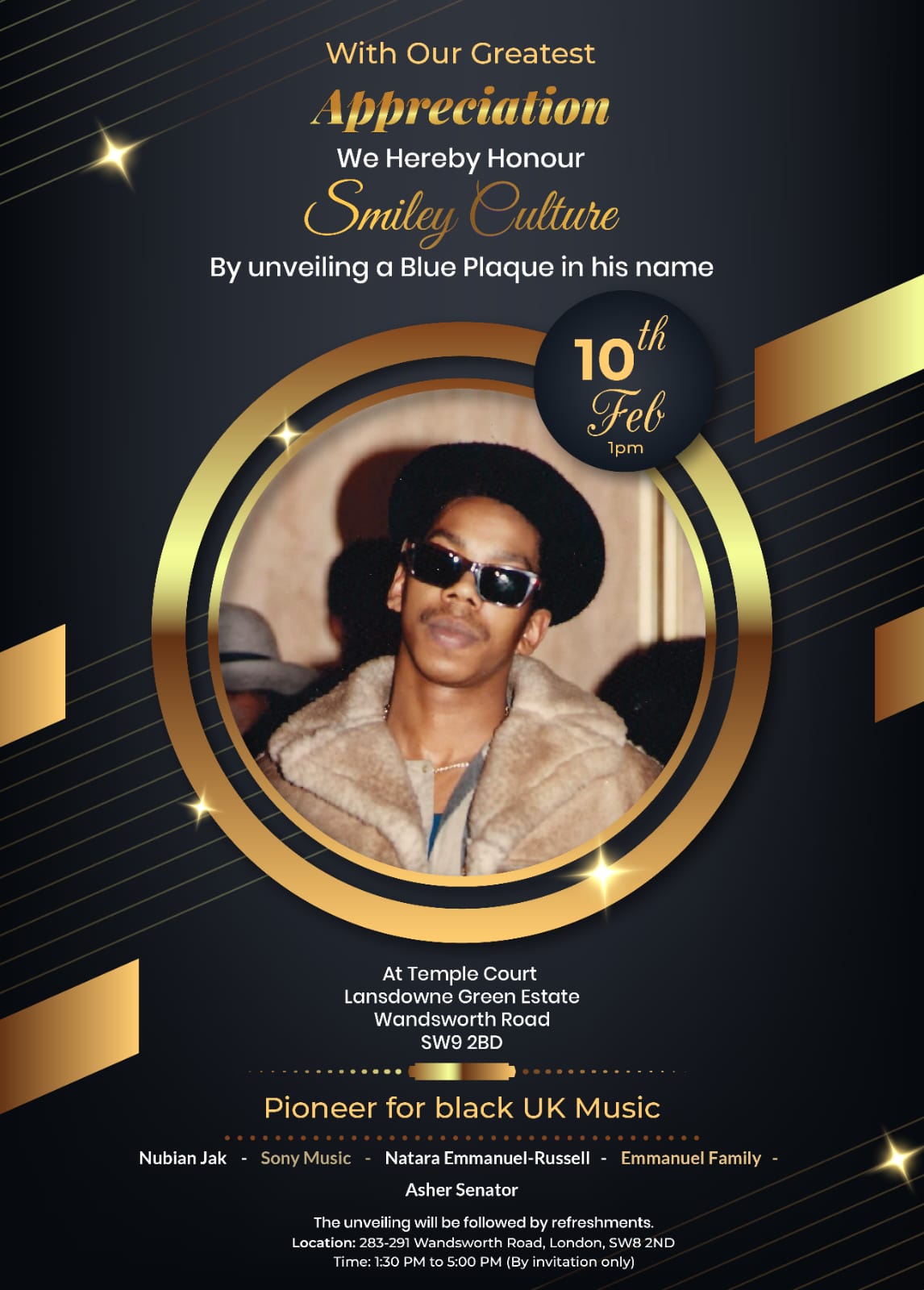
A Blue Plaque for Smiley Culture

I want to reflect on the recent unveiling of a Blue Plaque in honour of the British rapper, Smiley Culture. The event was jointly supported by The Nubian Jak Community Trust, Sony Music UK, and the Emmanuel family.  The “event mark[ed] an incredible milestone in recognising Smiley Culture’s impact as a cultural bridge, musical trailblazer, and voice of the people [and] … celebrate[ed] his enduring legacy and contributions to Black British heritage. We were joined by JP Ennis, the Mayor of Lambeth, Charlotte Edgeworth from the Sony Music Justice Fund, musical collaborators Asher Senator and John Dub Vendor, as well as Smiley Cultures family. It was an honour to meet Smiley Culture’s family who had been generous enough to invite me to participate alongside his grandson Zaire’s incredibly moving and impressive performance of Smiley Culture’s single Cockney Translation

Drugged up methodologies

Last week I had the honour of acting as discussant at a panel on Modern Britain On Drugs at this year’s MBS conference at Birmingham University. (It was a really great conference, but more on that another time.)

Peder Clark, London School of Hygiene and Tropical Medicine: ‘“Do You Love What You Feel?”: Ecstasy, Rave, and Ways of Knowing, 1988-1995’.

 Ben Mechen, Royal Holloway ‘Rubber Gloves and Liquid Gold: Poppers and the Policing of London’s Queer Nightlife’.

 Yewande Okuleye, University of Leicester ‘You Call It Marijuana and I Call It “The Herb”: Cannabis as a Boundary Object’.

Continue reading Drugged up methodologies

Referencing sisterhood.– ego, guilt and being kind

I want to think about the possibility of working, together, kindly with respect. When your own institution lists ‘kindness’ as one of its key strategies there are interesting possibilities in the feelings at work, at work.

Kindness

We will seek to be known as a ‘kind’ institution. We will care for each other and for the world around us, in responsible and sustainable ways. We will value collegiality and mutual support across all of our actions and activities. Sussex2020 Strategic Framework

So this blog is a way to explore how to protect the parts of ourselves that we give away when our personal is political. As Sara Ahmed says ‘to live a feminist life is to be a feminist at work’.  But that means my institution gets a whole load of stuff out of me that was never in my job description. It means that when I’m evaluated, fedback upon, quantified, its not just my outputs, but my whole personal and political self that’s being measured. Furthermore, feminism is a beautiful, stretchy, broad old chorus, and its never simple when ‘being a feminist at work’ is by necessity informed by your own personal as political.

Continue reading Referencing sisterhood.– ego, guilt and being kind

Jubilee and memories of punk


This blog post is based on a piece I was commissioned to write for the programme for a new theatrical production of Derek Jarman’s Jubilee adapted by Chris Goode. 

Continue reading Jubilee and memories of punk

Yeah, I don’t know where to begin so I’ll start by saying I refuse to forget you

The single is dead, so why is the charity single still going? There are so many other ways of soliciting donations to charity; by text, by paypal, by cash point.  It seems anachronistic to return to the charity single model, where musicians donate their labour in exchange for a financial donation from consumers . Yet time and again it is the default response that marks the significance of an event.

Each time a new charity single comes out it makes me think about what is at stake  – what problems are being responded to? what solutions are being offered? Who is helping whom and why?

Continue reading Yeah, I don’t know where to begin so I’ll start by saying I refuse to forget you

Queerama – Docfest 2017

queerama_poster

Thoughts on Queerama as Queer History.

The history of queer representation in film is sometimes the history of not being easily seen. It can be the history of having to work really hard to find yourself represented. It can be the history of having to work really hard with what you are given, when you are represented as the freak, the pervert, the duplicitous spy, the blackmailer.

Queerama for me, was the story of how people have negotiated the identities that have been imposed on them.  As a history Queerama shows us a series of outside definitions of queer identities that have had to be negotiated;  homosexuality, for example, has been seen as a sin,  an illness, to an act of dissidence.  Sexualities and their identities have been legislated and defined from above, diagnosed by sexologists,  feared for contagion, dissected like a guinea pig,  but they have also been squeezed through the cracks.

Continue reading Queerama – Docfest 2017

Do I know anyone who has worked on Jersey in the 80s?….. well funnily enough…

Capture

(Thanks to Claire Langhamer who excelled herself as travel companion/carer)

I’ve just got back from the launch of Jersey Heritage’s new exhibition ‘Bergerac’s Island: Jersey in the 1980s’.  I’ve been working with the team throughout the project’s development and can honestly say the whole experience has been brilliant. This exhibition is clever stuff. It speaks across generation, to the local and the global. But it is also touching, funny and engaging – that’s pretty much what I want history to be.

Continue reading Do I know anyone who has worked on Jersey in the 80s?….. well funnily enough…

KISMIF: Process not subject – it’s the way that we rhyme

I’ve just got back from the most mind-blowing conference I’ve ever been to.  Keep It Simple, Make It Fast, is a conference/music and literary festival/art show organised around DIY cultures, Spaces, Places.  Events were held across various venues in Porto, bringing together academic presentations, some celebrity guests, live performances, exhibitions with daily book launches and a summer school. The event is convened by Paula Guerra and Andy Bennett with an incredible team of international volunteers. I went with my Subcultures Network army (Matt Worley, Petes Webb and Ward, David Wilkinson and stayed in a seminary with the Punk Scholars Network and Steve Ignorant from Crass).

Continue reading KISMIF: Process not subject – it’s the way that we rhyme

A week ago we stood together: is it fixed yet?


I’ve been out of the country for a week at a great workshop in Berlin “How to Write and Conceptualize the History of Youth Cultures” organised by Felix Fuhg, Doctoral Student, with the Centre for Metropolitan studies.  I was travelling with the histrrry girls and The Subcultures Network, so there were Harringtons. There are always Harringtons.  We spent one day working and talking in the Archiv der Jugendkulturen.   Its an incredible community archive and library that has brought together all the different traces of resistance in youth culture and subcultures.  From magazines made by school pupils to the Love Parades’ backdrops and giant cut outs of Nena – the transational and hyper local are boxed up together and are being carefully catalogued by local participant experts in each scene.

13592269_10153566591906965_8298937792540976513_n

Continue reading A week ago we stood together: is it fixed yet?